

Big Mistake
(Big. Huge!)
debris:
Palm trees are not native to Los Angeles. They actually come from David Hockney’s A Bigger Splash.
oh oh oh:
Last Thursday marked one year of my plant-y paragraphs in your inbox. Groundcherry is, and will remain, a free publication, but paid subscriptions are available if you’ve got a few dollars (in RuPaulish, doulahs) to share. For just $5 a month, you can keep me in the lifestyle to which I’ve become accustomed: taking the bus, drinking generic soda water, reusing contact lenses, etc. Click the green button below for details.
and then also:
On the underside of a duckweed plant is a vegetative pouch. Inside that vegetative pouch are meristem cells. Within those cells is a sort of flexibility, an agnosticism about identity. They could be any sort of cell, could even be another plant.
Duckweed, as I mentioned a few weeks back, reproduces by cloning itself within its vegetative pouch. Often, cloning creates a “daughter” plant, connected to the mother by a stem-like structure called a “stipe.” In more challenging times, cloning results in a “turion,” which sinks to the bottom of the water column and waits for a scene more conducive to living. That duckweed can do this, and can do it at such great speeds—producing up to seven generations in thirty days—might make the individual plants seem a bit un-special. That’s how Georges Bataille saw them, anyhow.
I know I’ve been yapping about Bataille for weeks, but I also know that email newsletters are a dime a do-zillion. You’ve got a lot going on.
Georges Bataille was a French writer who lived in the late 1800s and early 1990s. His big thing was waste, excess. Though little attention is paid to him in today’s academic circles, he influenced many well-knowns—Sartre, Derrida, Deleuze, Lacan, Foucault. (It’s raining men, etc.)
Bataille—as I explained last week—saw animal reproduction as a spectacular moment of excess, of energies collected across a lifetime and then wasted on the creation of a singular, irreplaceable creature whose existence will terminate in a fetid, rotting death. It’s exciting to consider that the very center of life might be waste, excess—that living might not be about productivity but about what cannot be made useful, what cannot be recuperated or recycled. And it’s very wow, the animals, let’s have a parade for them on the BBC. Fireworks! Jazz! But Bataille’s thoughts on plants were less inspiring. In plants like duckweed, he didn’t see any grand expenditures, any explosions of being. Instead, in duckweed, he found a kind of dull duplication, a kind of “miserly growth.”
However much time Bataille spent working out his global image of living waste, it’s clear to me that he didn’t spend much time observing plants. Consider, for instance, Agave americana. Its common name—century plant—gives a hint as to its endurance in the landscape, though it doesn’t tend to live quite a full century. Century plant blooms only once, after amassing the root structure and leaf coverage to pay for the expense. Its flower stalk rises twenty to thirty feet above the ground, crowned with a panicle that looks like an asparagus spear gone mad. It puts everything it has towards reproduction, even though that reproduction often results in clonal plants (pups). Still, the very act of reproduction ends its life.
Or consider any bit of lettuce or kale growing in your garden today. One good heatwave will trigger bolting—the sudden, rapid construction of flowering structures. During bolting, leaf output decreases and the existing leaves become bitter to the human tongue. After bolting, fruiting, and setting seed, the bolting plants will die. In this moment of climactic stress, the plant spends everything it has—just as Bataille imagines animals do during sex.
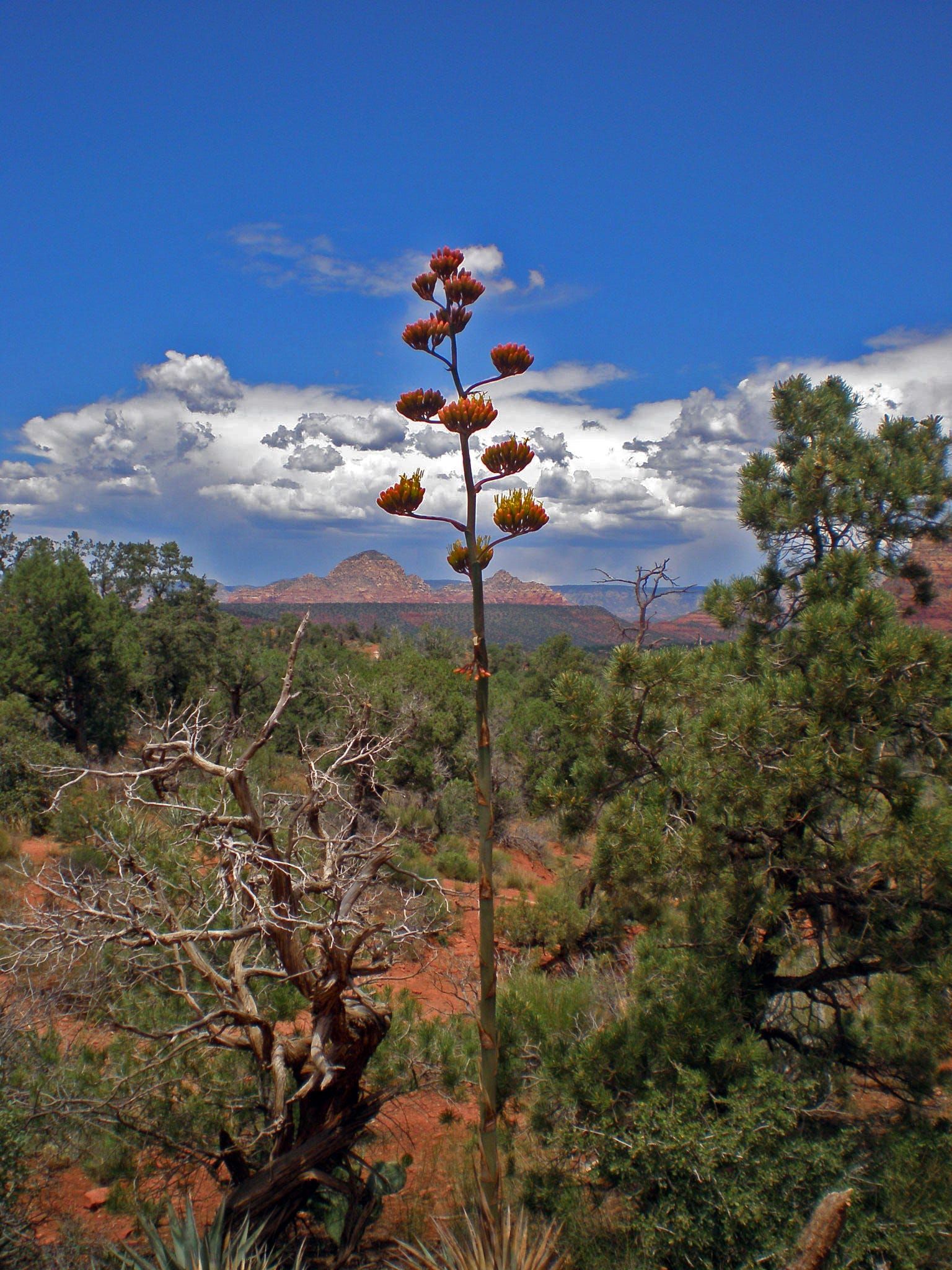

Plant examples in this vein aren’t hard to find—corpse flower, spring ephemeral, annual Helianthus. Reproduction can take everything a plant has to give. But even if it doesn’t, as in the case of duckweed, does that make its reproduction less spectacular?
Perhaps the trouble is that duckweed creates clones, and clones are imagined to be hollow, uncanny, or even soul-less. Television, film, and fiction have explored (to death) the question of whether a human clone is a real human, has real human autonomy, has the human individuality we so treasure. Some of those explorations touch on the more troubling question at center: do any of us have any of those things in the first place?
After all, you were already somebody else’s body. The egg cell which became you began as an egg cell inside your mother’s body, itself tucked inside your grandmother’s body. It was assembled through the biological processes of your grandmother’s living, elaborated upon by your mother’s life. The idea that you are an unprecedented individual is a heavily filtered account of the cellular material which brought you together. The idea of your individuality continues to require redaction. The plants and/or animals you consume, the microscopic inhabitants of “your” intestines, skin, eyelashes, all contribute to the wellness, the continued living of something you call you and not them. And still, those creatures are viewed as in you or on you, and not you. I think that, if we look more carefully, we will find that one human being is a repetition of several other humans beings, of multitudinous non-human beings, of the problem of knowing the human from the non-human. We are bundles of willed ignorance, not points of spectacular individuality.

And, then again, we are spectacularly individual. Somewhere, I think, Jacques Derrida writes that the death of one person is the death of a whole world. Never again will the world be configured as it was prior to that death. The gut microbes will die in their host, along with the eyelash mites and the imagined parasites. All those beings and their connections will be removed from what we see as society, what we see as life. It’s an end to which nothing else can compare. Infinite.
Looking at what plants do, and looking more carefully at what animals (including humans) do, can we be so sure we’re individuals in a way which clonally produced duckweed fronds are not? And if that individuality is a little less certain than it seemed, is possible that our lives and deaths are not exceptional expenditures of energy? Is it possible that plants are as spectacularly wasteful, as exquisitely excessive as us? That their lives and deaths are gasp-worthy, shocking even? And could it be that Georges Bataille’s hierarchy was a product of how he observed, and not reflective of the truth of things?
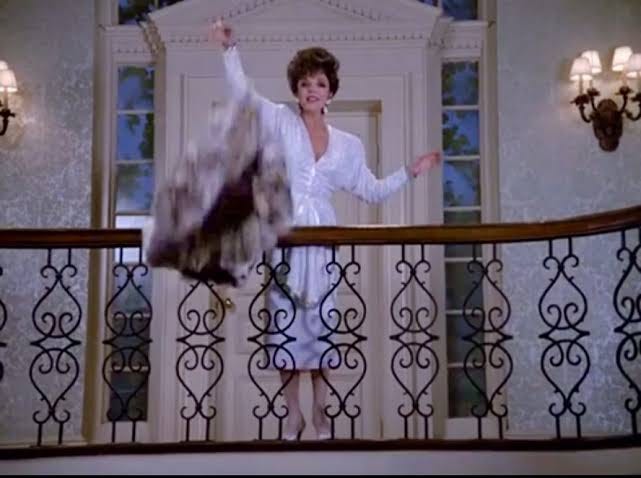
I love big moments of splendor—that’s what drew me to Bataille in the first place. I love the huge canvas drenched in pigment, the firework smoking up the air for no good reason, the scene in Dynasty where Alexis kicks Blake and Krystle out of the mansion—even if Blake tries to kill her for it. I’m not sure why one ought to stay alive except for these moments, and I don’t think humans (or animals) are the only ones having them. If we re-attune our vision, I think we’ll see dramatic scenes all around us. But we have to look small and strange, in multiples and distortions, through warped dreams and confused desires, and into mucky ponds.
Now,
take your junk. And your blonde tramp. And get out of my newsletter.
Upcoming Performances & Readings
the future is a trap!
okay:
I spend a lot of time trying to move my big toe, which makes me think of Kill Bill. I don’t look that good in yellow, though.