

Step Away from the Headphones
Podcast-sponsored plant thoughts
debris:
The ha-ha was a trench used to protect private lawns and gardens.
On The Golden Girls, Mr. Haha had a hotdog restaurant where he hosted birthday parties: Mr. Haha’s Hotdog Hacienda.
If there had been a ha-ha inside of Mr. Haha’s Hotdog Hacienda, it could have been Mr. Haha’s Hotdog Ha-hahacienda. Or, if the hotdogs were in ha-has, Mr. Haha’s Ha-ha Hotdog Hacienda.
I mourn for the worlds we have not seen.
and then also:
What everyone tells you about disability, and what is impossible to fully grasp about disability until you’re in the midst of it, is that it turns the world grey. Chummy bars and plucky art spaces become mazes of potential re-injury—if it’s possible to enter them at all. Strangers talk to one another at high volume about the absence or presence of limping, about what kind of accident has caused this unshapely body to take form in front of them, about their unfamiliarity with mobility aides. Meanwhile, an eight minute public transit delay becomes eight minutes of wishing for cheaper Ubers or—and I know this is a lot to ask of this city—a fucking bench at the bus stop. I hesitate, here in my sixth month of Achilles hell, to tell you all this. That’s another thing everyone tells you about disability: you won’t want to talk about it. It will seem impolite, morbid, or even self-indulgent. I hesitate to even talk about myself as disabled, but disabled writers have long argued that being able-bodied is a temporary condition. Everyone, if they’re lucky to live long enough, becomes disabled. I write now with the hope that I’m sorting out thoughts and feelings I’ll need again later.
I know disability isn’t a plant, and we’re here to talk about plants, and I promise I’m getting to it. I am. But I move slower these days. Slow down.
What nobody tells you about disability is that it puts you at risk for podcast delusion. In a world of AI psychosis and “schizogram,” surely we can admit that podcasts trouble our steady senses, too. To displace the quiet in my ears, I stuff them with the words of people I do not know: psychoanalysts lamenting racism in the clinic; botanists worshiping rare plants; conspiracy theorists drawing lines in red string. Among the hypnotic chorus, too, were philosophers talking about Georges Bataille.
Georges Bataille, born in 1897, was a French writer and maybe philosopher. I am not sure if he considered himself a philosopher, but I consider him a top-quality hater. At points, he hated philosophy, hated economics, hated art, hated the natural sciences. His hatred didn’t keep him away from those disciplines, but kept him in their orbit. He kept going back, trying to make biology talk to anthropology, or make art talk to Russian wheat markets. Maybe he saw potential in them, or maybe he didn’t know how to lose.
Me, I became stuck on Bataille back in 2018, when a friend recommended Bataille’s writing to me—in particular, his essay “The Language of Flowers.” I wasn’t much charmed by “Language,” but continued to read other essays in the same collection. His words were fiery and gross, muddy and aggressive. He suggested that we should understand the world in terms of the things we most disavow: shit, bugs, trash. I think different thoughts because I read Bataille, and I’ve written repeatedly about his ideas, including in Nobody’s Psychic and Cleveland Review of Books.
Bataille’s work influenced Jacques Derrida and Michel Foucault, but he is not discussed much these days. Reading him on my own, I became somewhat paranoid that I was misreading him, that I wasn’t smart enough to follow his ideas. Someone would, eventually, catch me out. So, I was emotionally receptive when the podcasting philosophers who chatted in my ear told me they were offering a month-long online course on Bataille. The course would be a chance for me to test my understanding, find the limits of my delusion. And, in a world of bars and buses not made for me, at least not for me for right now, what else was there to do with my time? I signed up. If writing about disability brings discomfort, writing about signing up for an online philosophy class advertised on a philosophy podcast brings an intense need to dissociate. There’s something about letting a podcast tell me what to do that is difficult to stomach.
The class was what you would imagine: PhD students and the bitterly post-academic lecturing encyclopedically. No detail was too small to be included, no trivia too trivial. And for those who wanted more
—and I am begging you to remember that the past six months have been rougher on me than Lady Bunny is on a wig—
there was a second, smaller class we could take. And you know exactly what I did. I got out my credit card, typed in some numbers, and became part of that second class. In the second class, we were expected to write and present a short text responding to Bataille’s ideas. It seemed the perfect opportunity to do what I’d long put off doing: write an essay on plants in Bataille’s writing.
So, for the next few weeks, I’ll be sharing bits of that podcast-induced essay. In particular, I’ll be looking at Bataille’s use of a plant known as duckweed.
What is duckweed?
You’ve got a whole week to figure that out.
xo
Dani
Upcoming Performances & Readings
May 30 — PGH Book Fest @ Hillman Library—11:30 AM-12:30 PM
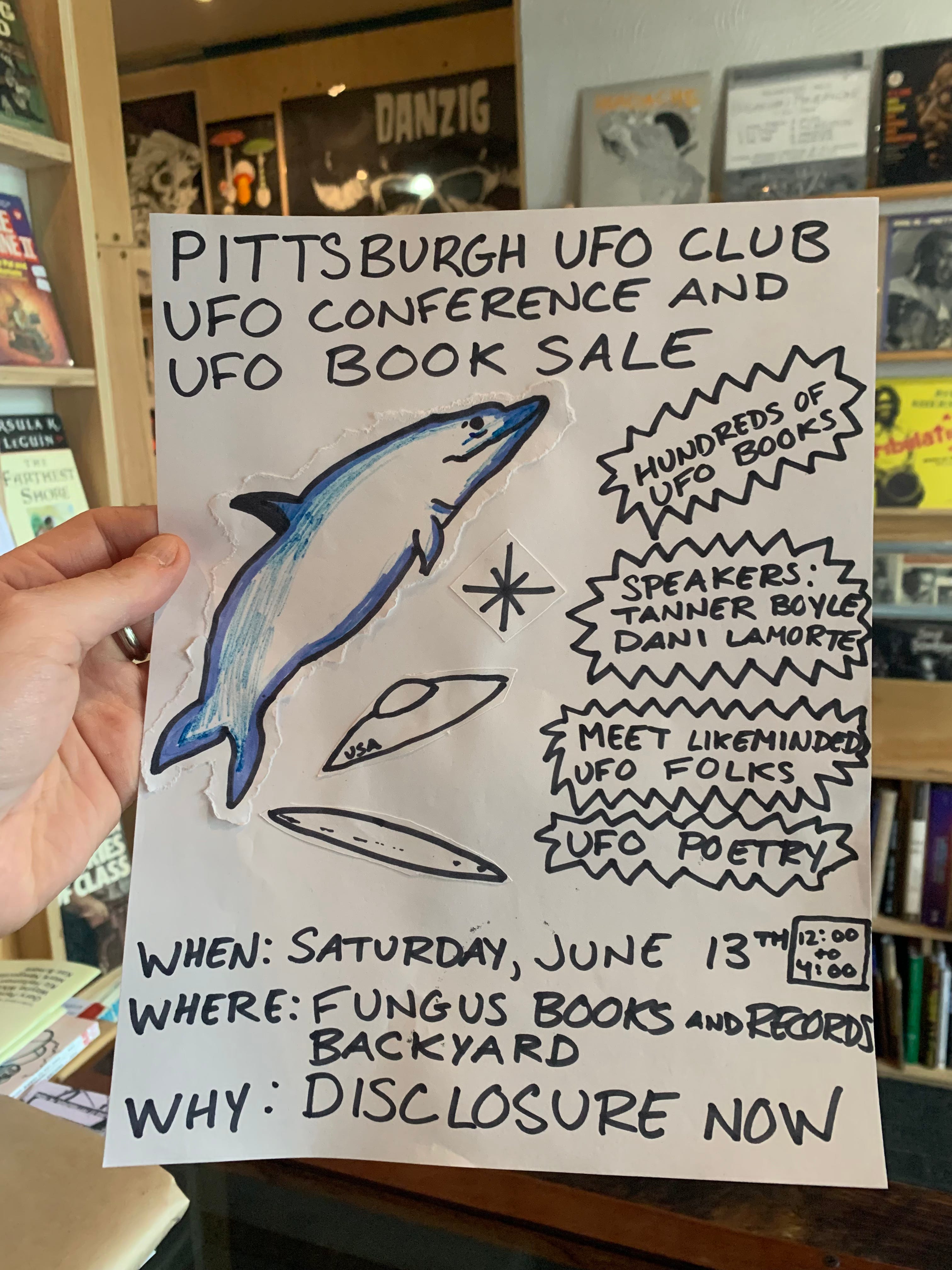
June 13 — PGH UFO Club Book Sale @ Fungus Books — 12:00 PM
okay:
Lately, it’s dandelions.