

The Origin of Errata
Questions we ask about plants, and the answers we get.

debris:
Yesterday, on a very slow hobble-walk around my neighborhood, I spotted polyester Alocacia leaves scattered across several front lawns. I take this as a sign that fake plant spring is near.
and then also:
My citrus dispatches have been a bit faulty, but this is a good thing. It’s citrus-like. Take, for instance, the grapefruit—an orb of fragrant English error.
When colonists brought pomelo and sweet orange trees to Barbados in the early 1700s, they had—as you might assume from any film depicting the English countryside—limited experience with citrus. It was this lack of experience, J. Kumamoto writes, that allowed the grapefruit—a hybrid of pomelo and sweet orange—to emerge. Pomelo is “self-incompatible,” to use the botanical term. Although pomelo flowers contain both pollen and ova, the flowers of a single pomelo tree are not capable of reproducing on their own; they require the pollen from a different pomelo tree. But the English likely didn’t know this. They may not have thought of pollen as key to reproduction at all. The discovery that pollen contains “male” reproductive matter had only been made in the late 1600s, and this itself was a scandal. As Joela Jacobs explains, earlier botanists had assumed that plants were female by default and “conjectured that both women and plants experience[d] a passive, sort of sexless sexuality.”
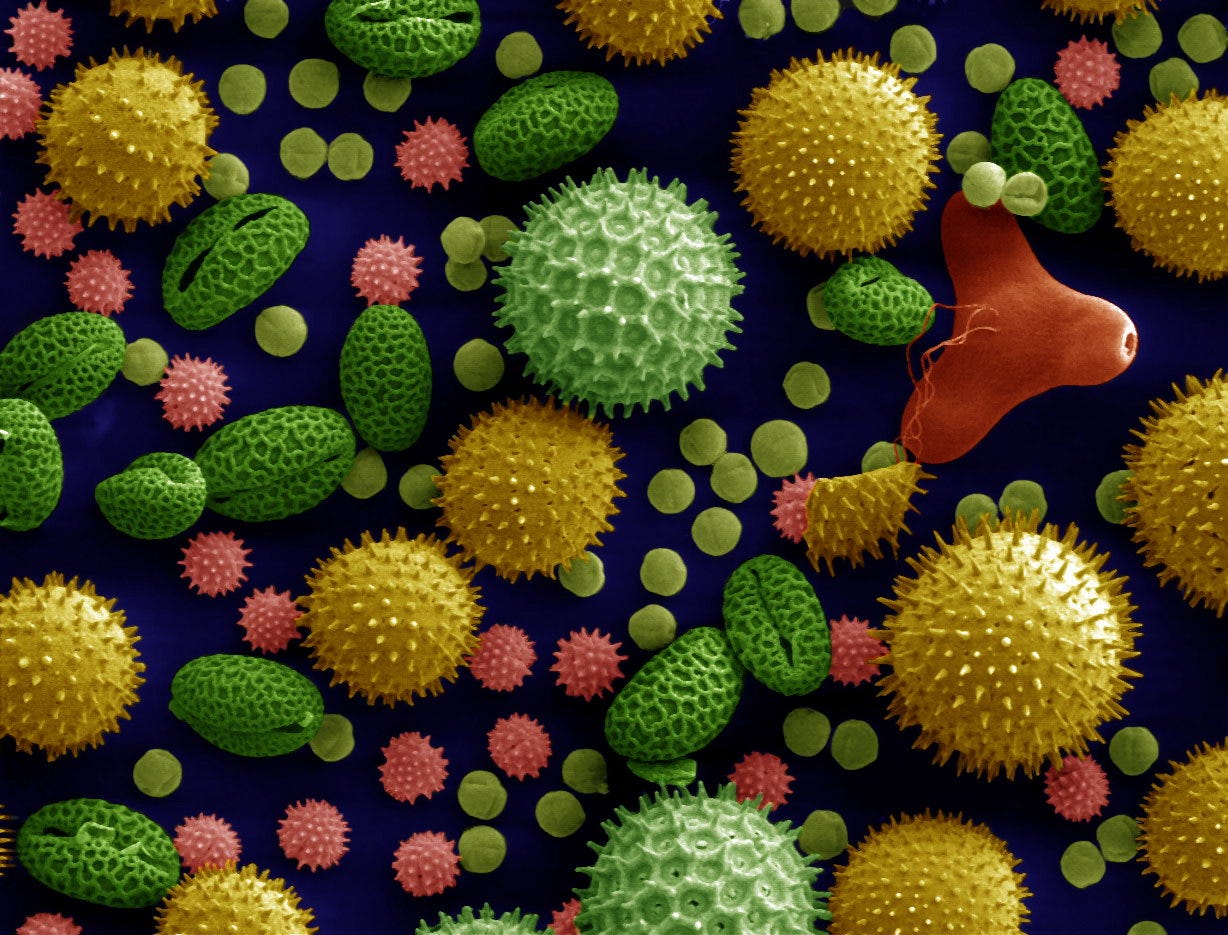

Bringing with them an ignorance of pomelo reproduction requirements, and perhaps an ignorance of pollen, the English colonists planted some pomelo trees and some sweet orange trees on Barbados. Without sufficient pomelo trees in sufficient proximity to one another, the pomelos were quickly cross-pollinated by the nearby sweet orange trees. Grapefruits followed.
Botanists consider grapefruit to be a hybrid and not a species of citrus. Species, to use a fairly rough definition, is the “largest [taxonomical] group of organisms in which any two individuals of the appropriate sexes or mating types can produce fertile offspring.” In other words, two house cats can mate and produce fertile offspring, making house cats a species. A house cat cannot, however, mate with a house fly, a house mouse, or a housekeeper and get the same result. These sundry creatures belong to distinct species. But the many species within the genus Citrus readily and regularly “mate” with one another. While this hybridization can lead to sterility, several citrus hybrids are plenty fertile—the lemon and sweet orange among them. For this reason, some writers consider all of Citrus to be a “superspecies”—meaning that the genus Citrus might contain one big hodge-podge of fruit-producing trees, none of which are clearly distinct species. Even among those who believe that Citrus contains a set number of species, it’s not agreed how many species there are. Most commercial citrus comes from citron, pomelo, and mandarin, but some citrus grow outside of this three-point fence: the Australian finger lime, the micrantha, the kumquat.
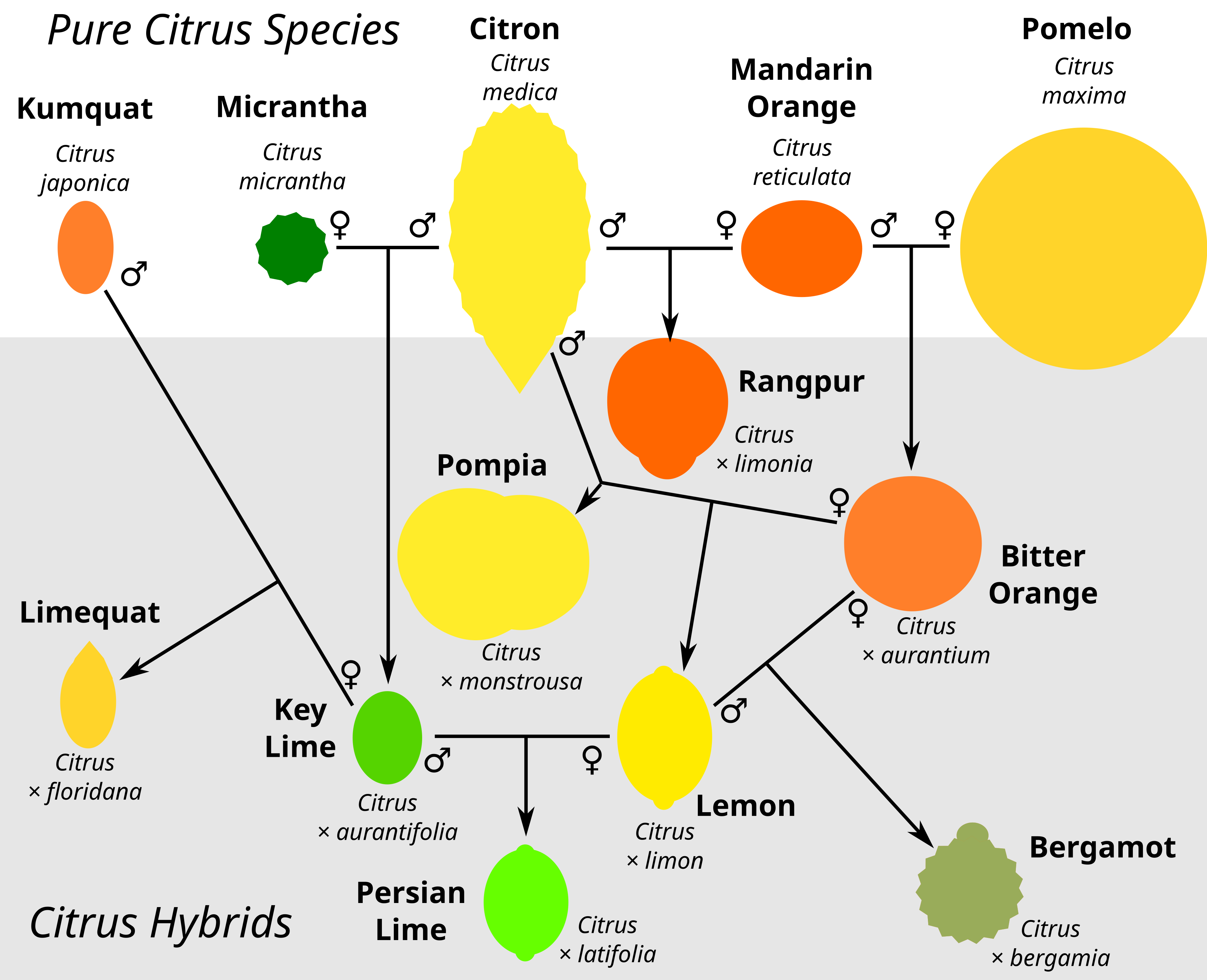

What is or isn’t a species, and what is or isn’t a member of the Citrus genus, depends on the questions you ask. When Linneas introduced his system of taxonomy in the 1700s, he determined the relationships between plants by asking about the number and arrangement of plant reproductive structures. How many petals do roses have? Five, or multiples thereof. Mustards, four petals to be seen. In more recent times, the study of plant genetic has organized plants by asking about the presence, absence, or configuration of chemicals which cannot be observed with the human eye. The study of plant genetics has resulted in the reclassification of many plants, as new questions overturn old determinations. For instance, when botanists reclassified mesquite trees from the genus Prosopis to the genera Neltuma and Strombocarpa, it wasn’t because the mesquite trees had changed. It was because the scientists were asking a different question than they had asked before.
The idea of a species, of distinct species populating the planet, is itself an answer to a question: How do I divide up this world? As a word, “species” “is a term from logic,” Donna Haraway tells us. It implies the sorting of things based on deduction: counting parts, spotting chemicals, then making those quantities meaningful for categorization. Often, species are treated as self-sealed, with the citron standing alone, separate from the mandarin or pomelo. Scientists are well aware that there is plenty of change going on within species, but we work with species as a category as though the imagined stability were real. Perhaps it’s happening too slowly for us to see, but new species are emerging and others are merging together. Species is a snapshot in time, made as much by the creatures observed as it is by the technology used to take the image.
Haraway, who is a biologist herself, has suggested other ways of thinking about species. In the early 2000s, she forwarded the idea of “companion species”—a method for paying attention to the real differences between creatures (in their biological functioning as well as their history) without pretending that species are hermetically sealed categories. A quick pop-science example of the individual’s plurality might be the millions (billions?) of nonhuman microbes which make the functioning of our human bodies possible. While there are real differences between me and the microbes in my gut, it’s undeniable that we can only exist in companionship with one another. In one sense, in the sense of paying close attention to the local vicissitudes of life and the unique histories of lifeforms, we are not the same species. In another sense, how could we not be a singular species together? Haraway’s “companion species” isn’t just a way of interpreting things, though. It’s also a call to action, a call to think about responsibility (or, as she might put it, response-ability) towards the many living entities and systems on this shared planet.
This is a tricky task for the mind. How do I write about me, think about me, without neglecting all the nonhuman lifeforms which are integral to me? Not just the microbes inside this body, but the juniper I watch from my window, the coffee plants whose roasted fruits characterize my morning—not to mention the other humans working on those coffee farms and the species they know. At the same time, how do I avoid a non-committal, wishy-washy magical thinking wherein I impose all my human intentions and feelings onto creatures so different from me? Wherein I pretend I can already theorize, already understand what life is for them?

Perhaps I wouldn’t have bothered to trouble my ongoing citrus story at all, but the next “citrus” I wanted to write about is the Sichuan pepper—and I worried the pepper wasn’t citrus enough. A cousin to the citrus in taxonomical terms, Sichuan pepper (Zanthoxylum bungeanum) is a shrub native to China, producing fruits used for incense, medicine, decoration, and—most exciting—cooking. I knew that the Sichuan pepper plant knew something about citrus the first time I smelled a bag of its dried fruits. They were saying something grapefruit-y, something lime-y. The tingly, numbing sensation they create on the tongue reminded me of biting into a lemon rind. Charts and papers and genetic sciences tell me that Sichuan pepper and Citrus diverged millions of years ago, but that’s what I learn if I ask “What is a Sichuan pepper? What is a Citrus?”
Perhaps I could learn something else if I asked other questions, questions like: “Who does a citrus fruit know?”
And in a tentative answer, I would say: I think she (let’s be feminist here) knows the Sichuan pepper.
Performances & Events
February 27, 2026 – Reading @ Bonfire Reading Series—6:45 PM
okay:
Not to be overly personal, but I bought a new bath mat and it looks just great.