

the only way is up
Ariana said "flowers from a tomb," y'know?
debris:
The French word for “cucumber” is concombre, which is sort of what it sounds like when you eat one.
oh oh oh:
This August, I’m collaborating with Silver Eye Center for Photography to bring you a photography + ecology reading group—FORECAST.
We’ll meet once a month to discuss Michelle Henning’s A Dirty History of Photography and exchange ideas about what it means to photograph a changing, weirding world.
Anyone with an interest in photography, ecology, plants, environmental studies, eco policy, etc. etc. etc. is welcome. Find more info on the Silver Eye website.
and then also:
I was at my third party on the fourth of July when two friends told me their one wish: that I would read Groundcherry aloud to them. So, here I am—a shooting star of botanical miscellanea—making dreams come true.
It’s not nice, not very polite, to call someone a climber, but that’s what she is—Morning Glory—she’s a climber. She climbs. Besides that whole “flowering in the morning” thing, climbing is what she’s known for.
Most plants grow upward, at least a little bit. The roots grow down, sure, and the branches might grow out, but the general direction of plant life tends to be up.
That’s where the sun is—up. Green plants use sunlight for basic metabolic processes, so they head towards the space explosion that keeps them going. But not all of them climb. Climbing is different, it’s a way of going up that also goes against or along. To climb, you’ve got have something to climb on, something that’s already sky-bound that you’re using as a vehicle for your own ascent. Morning Glory, she’s a climber—on fences and trellises, on sunflowers and tomatoes, on old sticks and new flagpoles. She’s climbing.
Climbing is a worthwhile strategy if you’re a plant. The higher you get, the more sunlight you can access. For an annual plant like morning glory, climbing a tall tree means not only getting closer to the sun, but getting past the tree that would otherwise shade you out. And it’s this capacity to compete, to get her way and get others out of her way that gets morning glory into trouble.
In the southeastern United States, morning glory is a garden plant, but she’s a farm pest, too. She’s a weed. According to a 1974 paper by Herbert G. Baker, weeds have twelve key characteristics. Those characteristics—like seed longevity or the ability to spread by rhizome—make it easier for some plants to out-compete others, and to be nearly impossible for humans to eradicate from a garden plot or farm acre. Morning glory’s seeds weather well, and germinate easily. The plant grows quickly, flowers repeatedly. The flowers are capable of self-pollinating, decreasing the plant’s reliance on pollinators. While self-pollination can result in “inbreeding depression,” a 2015 paper by Chase Mason shows that morning glory actually retains a good amount of genetic diversity—making it adaptable, flexible. A single morning glory plant can produce up to 10,000 seeds in a season. Reproductive success is almost a certainty. The next season, the whole thing starts again from those long-lasting, genetically diverse, quick germinating seeds. And then there’s another of Baker’s weed qualities: the climbing. As morning glory grows, she grabs hold of nearby supports—including other plants—and twists her stem around them. Cotton, corn, soybeans, peanuts—they’re all just ways for morning glory to get up.
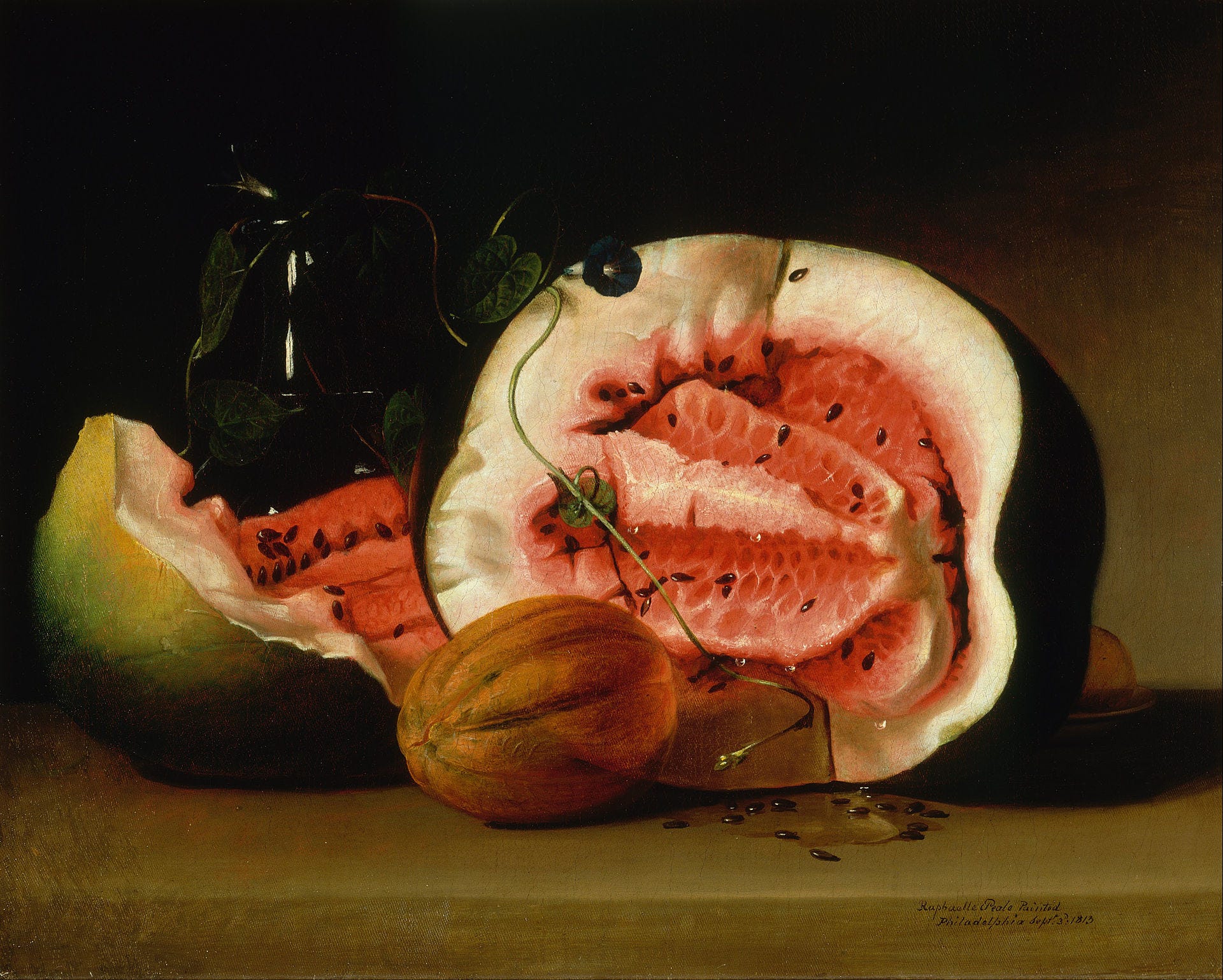
Up to the sun, right? To get up to the sun? That’s why she climbs, no? Maybe no. In a paper published earlier this year, Ernesto Gianoli asks the kind of question that upsets good reasoning: If plants climb to compete for sunlight, then why are there climbing plants in the desert, where there’s no chance of shade? Gianoli is considering the Atacama desert in Chile, but his point stands in other environments, too: spanish moss growing in Florida, mistletoe in the Arizona. Gianoli concludes that the variety of climbing plants in the Atacama suggests that there may be multiple evolutionary reasons for plants to climb. What originally encouraged morning glory to wrap itself around a nearby vertical stem might have been something other than the search for light.
And the how of morning glory’s climb is as unclear as the why. She doesn’t have any
listen, I don’t want to shock you but
morning glory doesn’t have any eyes. She’s climbing on all sorts of stuff, but she can’t see any of it. Or, she can’t see it like we see it, anyhow. 2007 experiments by Andrew Price and John Wilcut tried to sort out exactly what, if anything, morning glory is sensing to find her skyward ladder. It was suspected that far-red light might have a role to play. Far-red light is emitted by the sun, but plants don’t use those wavelengths for photosynthesis, so they reflect them back out into the world. As a result, the shade below plants contains a good amount of this far-red light. A shadow implies a presence and, for morning glory, a presence is a possible way up. Another possibility is that morning glories are skopotropic—darkness seeking.
Or maybe it’s neither. Price and Wilcut’s experiments didn’t show an obvious relationship between far-red light and how a morning glory finds its support. She just climbs. She just does it.
Maybe it’s not nice to say, that we don’t know why or how, but we don’t. We don’t know. She just does it.
Upcoming Performances & Readings
the future is a trap!
okay:
I’m done having poison ivy and I’m allowed to wear two shoes. Summer body, etc.
Now im thinking about climbing being used negatively. Annecdotally, I feel like its a gendered insult. And is primarily used by folks who want to maintain the social hierarchy because they are on top or they feel powerless to move upwards. Again, annecdotally, it seems to chastise people (women/fems ?) for seeking advancement of station through "unacceptable" (not masculine coded) means and arts. Going to listen to "fancy" for a while as research.