

morninglory
back, back, back, back again
debris:
The French word for “cucumber” is “concombre,” which is sort of what it sounds like when you eat one.
oh oh oh:
This August, I’m collaborating with Silver Eye Center for Photography to bring you a photography + ecology reading group—FORECAST.
We’ll meet once a month to discuss Michelle Henning’s A Dirty History of Photography and exchange ideas about what it means to photograph a changing, weirding world.
Anyone with an interest in photography, ecology, plants, environmental studies, eco policy, etc. etc. etc. is welcome. Find more info on the Silver Eye website.
and then also:
“We go ‘round in circles. We go up and down, up and down searching for love.”
— Beyoncé Knowles, PhD Botanical Sciences
That “conversation” should be Latin is to nobody a surprise. The prefix con- means “with” and versare means “to turn.” According to the Online Etymological Dictionary, a conversation was once another name for an abode or a practiced manner of doing something. I am at my conversation, writing to you, and writing to you is my conversation. In the 1570s, the term began to mean something like what it means today: a dialogue, a sharing of words.
Conversation isn’t so different from convolution: con- plus volvere, meaning “to roll.” Something which is convoluted rolls towards itself, forms a circle or a spiral. This is what plants in the family Convolvulaceae do. You’ll know Convolvulaceae—try saying that word aloud each time you read it—from a summer sunrise garden plant: the morning glory. Morning glories (genus Ipomoea) climb skyward by twining their stems around fence posts, clothing lines, and slender tree trunks. In my garden, climbing morning glory topples goldenrod stands, infiltrates yew shrubs, impersonates violet beds. Friendly leaves decorate the morning glory stem, as do trumpet-like flowers. The flowers of popular garden varieties can be an almost impossible blue: something cold but hot, dead but living.
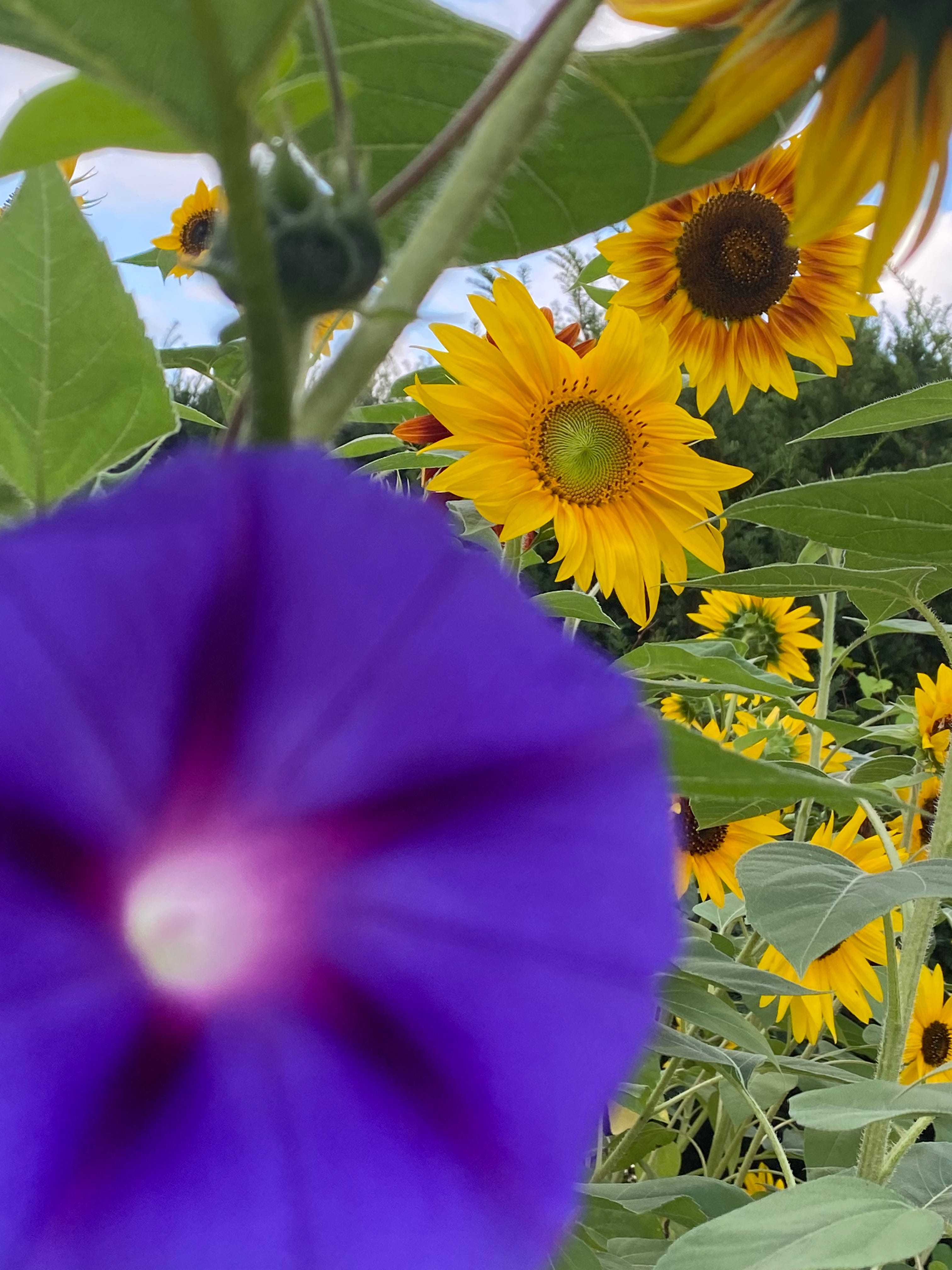
The morning glory of most American gardens is Ipomoea purpurea, a plant native to Mexico and Central America. In East Asia, Ipomoea aquatica is of more importance. I. aquatica, also known as Thai morning glory or water spinach, is an agricultural plant grown for its delicious leaves and stems. Another edible member of the Ipomoea genus, I. batatas appears on American Thanksgiving tables each year under the semi-true moniker “sweet potato.” The garden morning glory, it’s important to note, is not considered edible, though some people consume its seeds for a hallucinatory effect. (Talk about talking to yourself.)
In 2022, a group of researchers in Thailand looked into the possibility of making a bioplastic using soy protein isolate reinforced with morning glory stem fibers. Spoons containing more MGSF absorbed less moisture (and thus were less likely to disintegrate) but they also performed worse in bending and crushing tests. Researchers hypothesize the negative outcomes are the result of morning glory fibers being larger than soy protein structures, making it easier to break the spoons apart.
And maybe morning glory is more of a monologue anyway. Plants in Convolvulaceae tend to be self-compatible—meaning that a flower which contains both sperm and egg cells is capable of fertilizing itself. No bee or moth or bat or bird needs to transfer cells from one flower to another. Self-compatibility can vary depending on the genetic diversity of a population, however. A 2023 study found that Argyreia capitiformis flowers were more likely to produce seeds if they received pollen from a plant five to twenty meters away, suggesting that another flower’s pollen was not required but strongly preferred. In some cases, this can be a strategy for preventing “inbreeding depression”—the genetic narrowing of a species as a result of inbreeding.
I don’t know what the morning glory in my garden prefer. I don’t know if they’re getting their pollen from across the way, or keep things at home. I just know they produce a wild quantity of seeds each year. Other than that, they keep me out of the loop.
Upcoming Performances & Readings
the future is a trap!
okay:
I’m no longer afraid of poison ivy, but I’m pretty sure I’ve got it on my hands.