

Grapefruit, or it didn't happen.
Up to something.

debris:
Wikipedia tells me that “a glume is a bract below a spikelet in the inflorescence of grasses.” But when I hear the word “glume,” I just think of a sad, sad Heidi Klum. So sad, the glume.
and then also:
It’s possible that the grapefruit doesn’t exist; it’s likely that the shaddock does.
“Shaddock” was the local name for Malus aurantium or Aurantium indicum—a fruit found on the island of Barbados as early as 1687. Now known as Citrus maxima or pomelo, the fruit had somehow made its way from Southeast Asia, where it originated, to the Atlantic. The eighteenth-century naturalist Hans Sloane gave credit to one Captain Shaddock of the British East India Company, who was said to have brought pomelo seeds with him to Barbados.
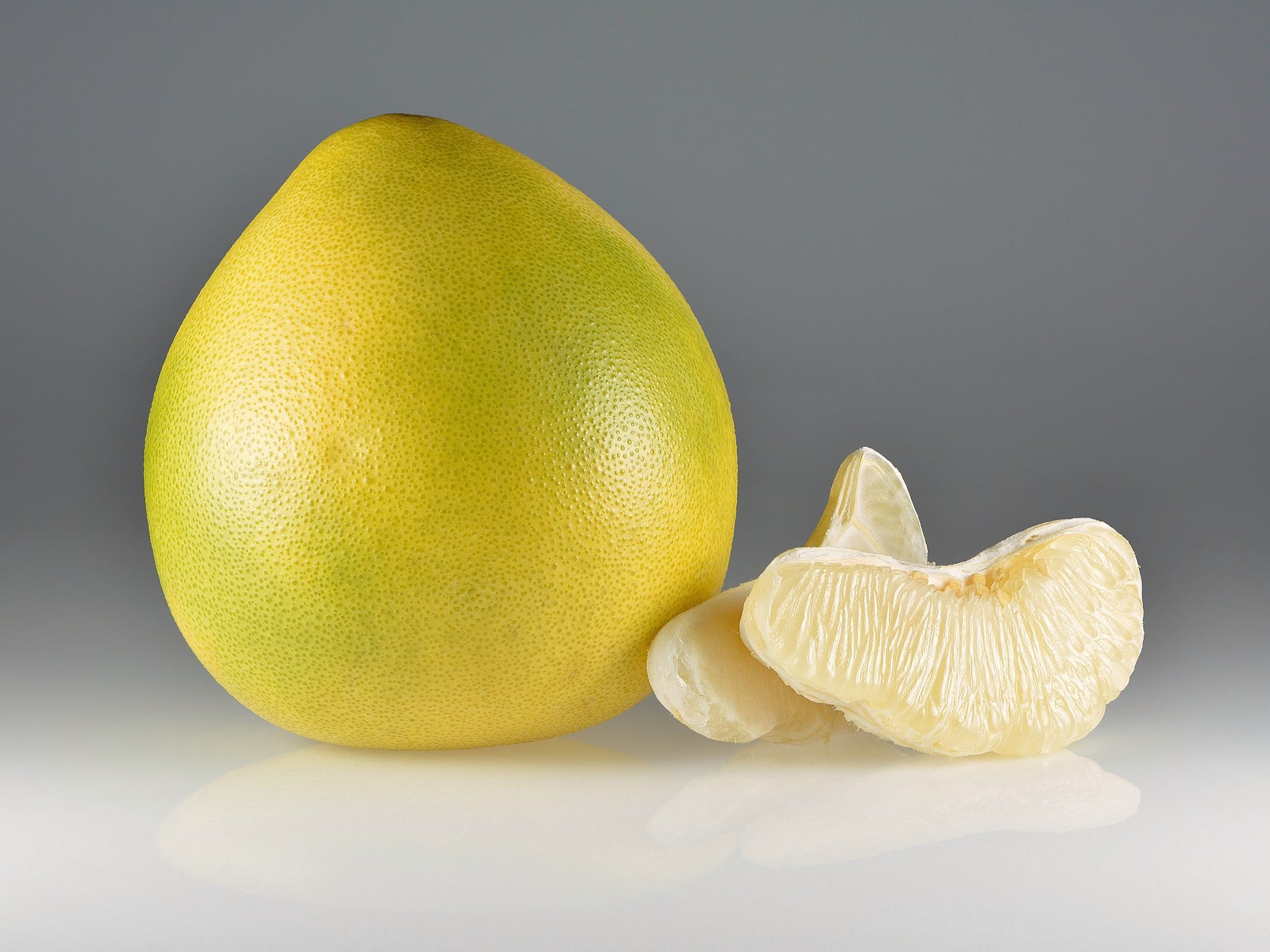

Within a few decades, Shaddock’s seeds turned into trees, producing shaddock fruits as well as something locals called “forbidden fruit.” In 1750, Griffin Hughes described Barbados’ shaddock and forbidden fruit, alongside two other citrus found on the island: “Chinese orange” and bitter orange. The forbidden fruit, he wrote, was “pyriform”—shaped like a pear.
Forbidden fruit seeds soon made their way to Jamaica, where botanist Patrick Browne described the resulting trees and fruits. Unlike Hughes, Browne wrote that the forbidden fruit was sphaerico—spherical. John Lunan, another Jamaican botanist, concurred with Browne, describing the Jamaican forbidden fruit as spherical. In addition to the shaddock and forbidden fruit, there was something else growing on the island:
“There is a variety known by the name of grape-fruit on account of its resemblance in flavour to the grape.”
Delicious as the grape-fruit was, Lunan wrote that it had a serious problem: If you collected the seeds from these grape-fruits and planted them, only a few would turn into trees with tasty fruits. The rest would produce fruit of another type. It was all a jumble. On at least two islands, two seemingly different citruses were growing under the same name: forbidden fruit. Now, there was now something called a grape-fruit capable of producing something other than a grape-fruit.
But Lunan’s complaint doesn’t align with what we know about the grapefruit today. The modern-day grapefruit, DNA testing has shown, is a pomelo-mandarin hybrid originating in 1600s Barbados. Through hybridization, grapefruit gained the ability to undertake apomictic reproduction, a form of asexual reproduction. In apomixis, embryo-containing seeds are produced by the grapefruit plant, even without fertilization. The resulting seeds are clones of the parent plant. Despite apomixis, grapefruit flowers can also be fertilized sexually. Complicating things further, a single grapefruit seed can contain multiple embryos (“polyembryony”), meaning that a grapefruit seed can contain both apomictic clones and sexually-produced embryos. Apomictic clones tend to be much more competitive, though. Any new hybrids produced through sexual reproduction—say, between a grapefruit and another citrus on the island—aren’t likely to survive the early phases of growth.
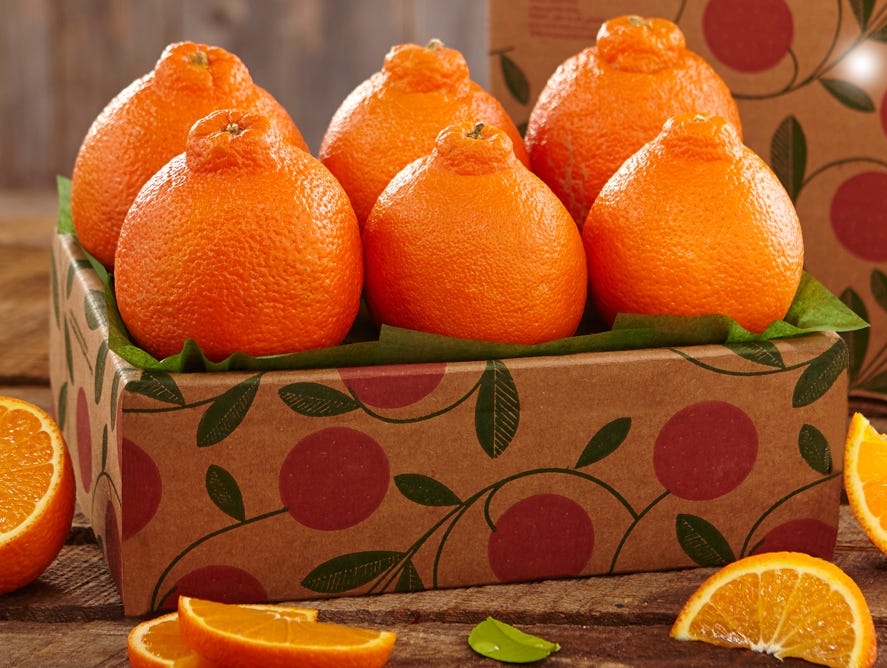
Lunan complained that grape-fruit seeds produced a variety of trees, but most modern-day grapefruit seeds contain clones of their parent plant. If his observation about the seeds was accurate, then he may have encountered some other kind of pomelo hybrid, not the grapefruit we know. Then again, Glenn C. Wright describes grapefruits as “genetically unstable.” Lunan could have stumbled across a cache of mutated grapefruit seeds, each diverging from their parent plant’s genetic code. Historians (and dilettante writers) still don’t know what Lunan was describing, or how close it was or wasn’t to today’s grapefruit. Like Lunan’s grape-fruit, Hughes’ pear-shaped forbidden fruit is also lost to time, though I suspect it looked something like a honeybell tangelo—itself a cross between a grapefruit and a tangerine.
In the early 1800s, Count Odette Philippe brought the seeds of some Caribbean “grapefruit” to Safety Harbor, on Florida’s western coast. The resulting grapefruit groves provided fruit for occasional shipments to New York City and Philadelphia, but grapefruit remained little more than a novelty to most Americans at the end of the nineteenth century. Gradually, consumer interest increased and production spread to Texas, California, and Arizona. In the early 1920s, Ethel Barrymore—actress and great-aunt to Drew Barrymore—promoted grapefruit as part of her diet. By 1929, grapefruit was included in the “Mayo Clinic diet,” said to be suitable for “fever patients, invalids and convalescents or indicated [for] weight loss.” Grapefruit’s popularity was likely aided by the Florida Citrus Commission, a semi-governmental marketing, lobbying, and research agency. As of 1949, the FCC employed one man whose sole assignment was to attend conferences and create citrus interest among doctors, nurses, nutritionists, and dieticians. Throughout much of the twentieth century, the idea that grapefruit had health special properties persisted in the form of the crash “grapefruit diet.”

Should you decide to have a grapefruit crashout, any grapefruit will (or won’t) work. Botanical historians believe that all grapefruit trees in the United States derive from Count Philippe’s Florida seeds. Philippe’s grapefruit cultivar was named the ‘Duncan’ grapefruit, from which came ‘Walters’ and ‘Marsh.’ Those two varieties branched off further, eventually producing red grapefruits through a random genetic mutation. While this tidy, traceable lineage on American shores makes for a more certain history, it also makes for a more challenging future. Since 2005, citrus growers in the United States have been combating HLB (short for huanglongbing), also known as citrus greening disease. HLB is caused by Candidatus liberibacter asiaticus (CLas) bacteria, spread by the Asian citrus psyllid (Diaphorina citri—gorgeous name!) Once HLB sets in, the grapefruit tree’s leaves become mottled, its fruit falls prematurely, and any remaining fruit becomes bitter. The genetic uniformity among grapefruit trees—100% similarity between Marsh Seedless, Duncan, Thompson Pink, Foster, and Red Blush cultivars—means that American grapefruits are almost uniformly susceptible to HLB. Between 2003 and 2023, HLB caused Florida citrus production to decrease by 94%. There’s no known cure or effective treatment for HLB. All farmers can do is destroy the diseased trees to prevent spread. Researchers are presently testing citrus rootstocks for HLB-resistance, and are also looking into transgenic options—like borrowing HLB-resistant genes from potatoes. Others hope to find wild pomelo hybrids that could be interbred with grapefruit, potentially bolstering the grapefruit’s genetic makeup.
For all the advanced research being undertaken to save the grapefruit’s future, there’s plenty we still don’t know about its past. We know that pomelo and mandarin hybridized—possibly several times—in Barbados, probably producing several different new fruits. We know some of those fruits were called shaddocks, some were called forbidden fruits, and some were called grape-fruits. Which was which, and which one we have now, isn’t entirely clear, though. And it’s not clear that Captain Shaddock, the man credited with bringing the pomelo to Barbados, ever did any such thing.
In their 1987 article on the origin of the grapefruit, J. Kumamoto and their colleagues tell us plainly:
Citrus historians and botanists have long been [...] unable to document the existence of a Captain Shaddock in the archives of the British Admiralty, the Hakluyt Society, or the [British] East India Company.
In 1966, H.W. Lawton found evidence of a Captain Chaddock, who sailed between Bermuda and Trinidad in 1642, but the Captain’s first name and ship name could not be found. Kumamoto followed-up, finding that, sometime between 1642 and 1650, an Englishman named Philip Chaddock indeed sailed past Bermuda en route to somewhere else, maybe Barbados. This vague Captain Chaddock, semi-documented in the annals of history and possibly passing by Barbados, is Kumamoto’s best guess at who brought the pomelo to the Atlantic. Kumamoto dismisses another possibility:
For many years, citrus historians considered the mysterious captain a legendary figure whose name possibly originated as a folk tradition to explain the word shaddock.
Maybe the shaddock fruit got its name by other, more obscure means: a joke, a misheard word, a bad translation. These are hybrid forms of knowledge, spoiling the distinction between things.
It’s an unsatisfying answer for citrus historians, but it’s ideal for a grapefruit.
Performances & Events
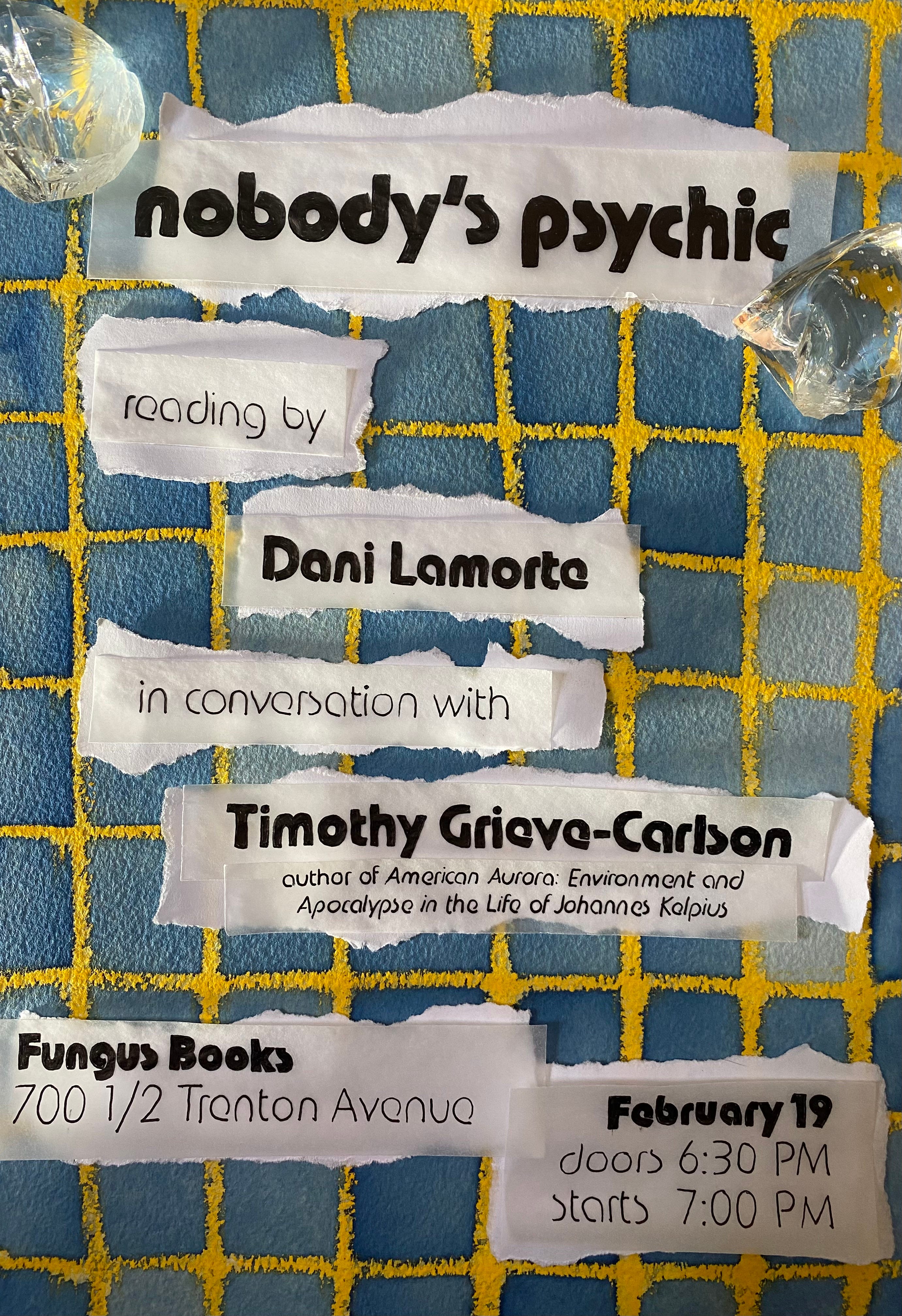
February 19, 2026 – Reading @ Fungus Books, with Timothy Grieve-Carlson—7:00 PM
February 22, 2026 – Reading @ City of Asylum—3:00 PM
February 27, 2026 – Reading @ Bonfire Reading Series—6:45 PM
okay:
My cat is sitting on my lap, threatening to type words unknown to humans. I send this dispatch with haste.